Use AI safely
How to Spot AI Mistakes: 7 Rules Before You Trust an Answer
AI chatbots write smoothly and sound sure of themselves, even when they are wrong. Experts call these wrong-but-confident answers "hallucinations". The good news: a few habits catch most of them.
Why AI makes mistakes
A chatbot predicts likely words based on patterns in huge amounts of text. That makes it great at explaining and writing. But it does not always know whether a fact is true, recent, or about your exact situation. So it can mix things up, use old information, or fill a gap with something that only sounds right.
The 7 rules
1. The more it matters, the more you check
A dinner idea does not need checking. A medicine dose, a legal deadline, a tax rule or a money decision always does. Use AI to understand the topic, then confirm with an official source or a professional.
2. Be suspicious of exact details
Names, dates, prices, statistics, quotes and links are where mistakes hide. If an answer gives a precise number, find that number somewhere else before you repeat it.
3. Ask for sources, then open them
We tested this. We asked ChatGPT for three scientific studies about electric scooters in Meknes, Morocco, a topic with almost no research. To its credit, it said it could not verify any study on exactly that topic, and offered related studies instead.
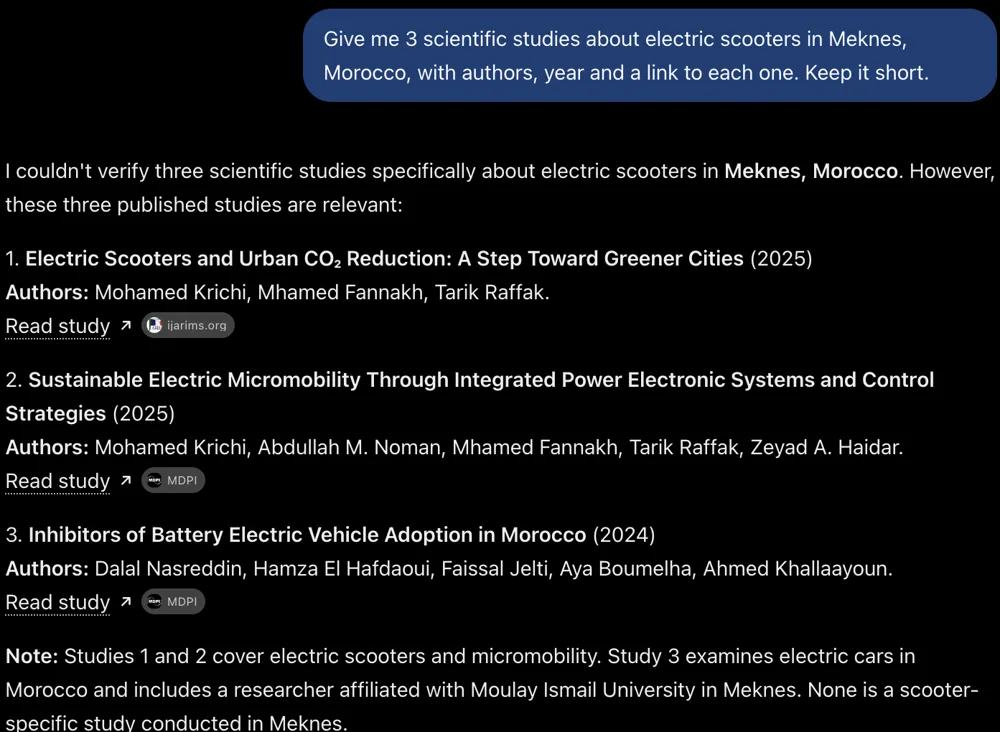
Then actually click them. Some chatbots can search the web and show real links. Others may describe sources that do not exist. A source only counts if you can open it and it says the same thing.
4. Ask it to check itself
This does not make the answer perfect, but it often reveals weak spots.
5. Watch the date
Prices, laws, product features and "the latest" anything change fast. Ask: "Is this current? When was this true?" and check the official website.
6. Ask a second time, differently
Ask the same question in a new chat, or in another chatbot. If the answers disagree, that is your signal to check carefully.
7. Use your common sense
If something sounds too good, too strange or too convenient, stop. You know your life better than any chatbot.
Quick checklist
| Type of answer | Risk | What to do |
|---|---|---|
| Ideas, drafts, rewording | Low | Use freely, edit to taste |
| Explanations of a topic | Medium | Good for learning; confirm key facts |
| Numbers, dates, prices, quotes | High | Always check a second source |
| Health, legal, money decisions | Very high | Use only to prepare questions for a professional |
Next: now that you know how to check answers, try 12 everyday things you can do with a free AI chatbot.
Get one AI tip every week
Short, practical, free.
One short email a week. You will get a confirmation email first. Unsubscribe any time. Privacy.